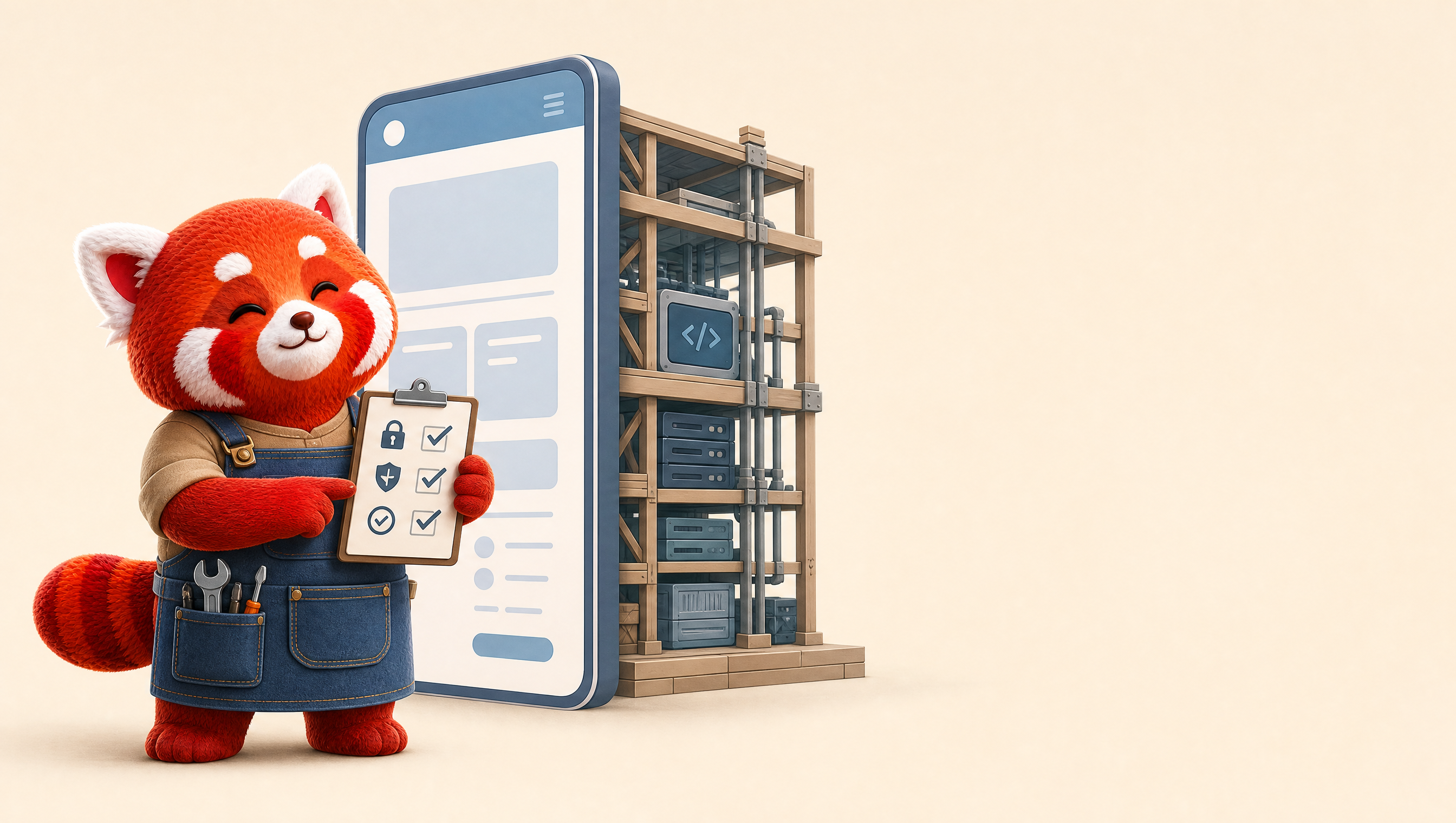
The demo always works. That's the part that draws so many people in. With AI in the mix, anyone can get something onto a screen in an afternoon, and it'll look finished. Buttons click, pages load, the thing does the thing.
Getting something you can hand real users, real data, and real money is a different job, and you can't skip straight to it. I use AI every day and I build fast, but I build carefully from the start, and lately a real part of my work is being called in to rescue apps that didn't. So this is the difference I run into constantly: "it works" and "it's done" are not the same sentence.
What a fast build actually gets you
What a fast AI build gets you is a demo that works on your own laptop. And on your laptop, everything cooperates. There's one user, which is you. The data is clean, because you typed in the three tidy examples yourself. And you only ever click the buttons in the right order, because you know the order.
This is roughly what the fast-and-loose style of building was meant for. The term "vibe coding" was coined in early 2025 by Andrej Karpathy, who described it as giving in to the vibes and forgetting the code even exists (Wikipedia). He was clear that it was fine for throwaway weekend projects. Fun, fast, disposable. The trouble starts when someone takes the weekend project and points it at real customers.
Where it falls apart: real users, real data, real money
Real life is nothing like your laptop, and this is where the apps I get called in to rescue come undone.
The first thing that breaks is other people. The app was only ever tested by one person, so the moment a handful of real users are on it at once, it buckles. Things that were instant for you crawl or fall over for everybody else.
Then there's the data. Your demo ran on a few clean rows you made up. Real users bring years of messy, half-finished, contradictory data, and the app has no idea what to do with any of it. AI tends to build the happy path, the version where everyone does the expected thing in the expected order. Real people don't. Someone double-clicks submit because it felt slow, and because nothing was written to catch that, the order goes through twice, or the data quietly corrupts.
And then there's the part that isn't scaring people enough. When I open these apps up to fix them, I keep finding personal data sitting exposed and login systems anyone could walk straight through. Auth, the unglamorous work of making sure the right person sees the right thing, is one of the hardest parts to get right and one of the first a fast build skips. So the app looks complete and comes apart the second a real person, or a curious one, shows up. I'm not the only one seeing this. There's a whole run of people writing about stumbling onto AI-built apps leaking their users' data (XDA).
The fundamentals are the whole difference
Here's what I've landed on after cleaning up enough of these. The difference between a demo and a real product is almost entirely the stuff a demo is built to not need.
- Real auth and security, so the right people see the right things and nobody else can help themselves to the rest.
- Validation and edge cases, so odd input gets handled instead of crashing the page.
- Error handling, so when something does go wrong it fails softly and tells someone, rather than corrupting data in silence.
- Data privacy and GDPR, because you're holding real people's information now, not your own test rows.
- Good design, the kind where a stranger can actually understand and use the thing. It's usually the first casualty of a rushed build, which is why so many of the apps I rescue are also just confusing to use.
None of that shows up in a demo. All of it is most of the actual work. A study of AI-assisted coding calls this the flow-debt tradeoff: the smoother and faster the generation feels, the more of this hidden work quietly piles up as debt you pay for later (arXiv).
Fast and solid aren't opposites, but you can't skip to solid
I want to be fair here, because I love building fast, and AI makes me quicker than I've ever been. Speed and solidity aren't enemies. You can move quickly and still end up with something sturdy. But you need to change your definition of quick right now. Quick in software development is NOT one weekend. It can go from a week to a few months, depending on the work being done.
And the fundamentals aren't an add-on you leave for the end. They shape how the whole thing is built, which is why I put them in from the very start instead of adding them later. Trying to retrofit real security, error handling, and sane structure onto a happy-path demo is usually slower and more painful than building it properly would have been. That's the whole reason the rescue work exists, and why it tends to cost more than doing it right the first time would have.
Shipping something I'd actually stand behind
So here's the bar I hold myself to. I won't put my name on something that only works when everything goes right. Anyone can make a thing work once, on a good day, with friendly data. Done means it works every time, on the worst input someone can throw at it, with real people who won't cooperate, while keeping their information safe.
That takes longer than a demo. It's supposed to. The demo is the exciting first hour. The reason you can trust the finished thing is all the careful, unglamorous work that comes after it already looks done. When someone hires me, that quiet part is what they're really paying for, and it's the part I care about most. 🐾